Bevel Stick Blade Blanks
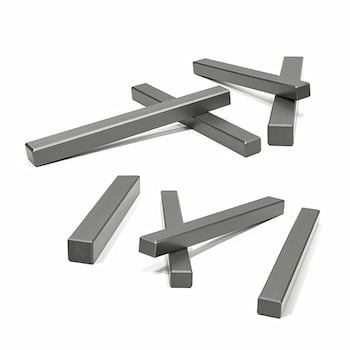
Type: Carbide Bevel Stick Blade Blanks
Dimensions: As per drawing or requested
Description: Customized, near-net-shape tungsten carbide blanks for manufacturing precision stick blade cutting tools used in spiral, hypoid, and Zerol bevel gear production.
Advantages of Carbide Bevel Stick Blade Blanks
Hyperion Materials & Technologies manufactures carbide bevel stick blade blanks engineered to help toolmakers produce precision gear cutting tools more efficiently. Hyperion’s sintered carbide blanks are manufactured close to the final tool geometry, reducing grinding and finishing requirements while supporting consistent cutting-edge performance.
Available in premium carbide grades, Hyperion’s bevel stick blade blanks combine wear resistance, toughness and dimensional stability to support accurate gear cutting and multiple tool resharpening cycles.
Hyperion’s customized carbide bevel stick blade blanks help toolmakers improve manufacturing efficiency while providing gear manufacturers with durable, precision cutting tools.
- Reduce Grinding Time: Near-net-shape geometries minimize stock removal, shortening grinding cycles and reducing tool manufacturing costs.
- Increase Toolmaking Throughput: Reduced processing time improves machine utilization, helping toolmakers produce more cutting tools with existing equipment.
- Extend Usable Tool Life: Wear-resistant carbide grades help finished stick blades maintain cutting geometry through multiple resharpening cycles.
- Attain Consistent Cutting Performance: Controlled blank geometry and material quality support cutting-edge integrity, dimensional stability and repeatable tool production.
- Lower Tooling Costs: Longer-lasting finished tools can help reduce replacement frequency, tooling inventory requirements, and machine downtime for gear manufacturers.
Carbide Grades and Mechanical Properties
Hyperion offers carbide grades for bevel stick blade blanks to provide the combination of hardness, toughness, and wear resistance required for specific gear cutting requirements.
|
Carbide Grade |
WC (%) |
Binder (%) |
Average Grain Size (µm) |
Density (g/cm³) |
TRS (N/mm²) |
Compressive Strength (N/mm²) |
Hardness (HRA) |
Hardness (HV30) |
|
H6F |
94 |
6 |
0.8 |
14.9 |
3,500 |
6,900 |
93.7 |
1,775 |
|
AM50 |
93 |
7 |
0.6 |
14.7 |
3,400 |
7,400 |
93.7 |
1,870 |
|
H10F |
90 |
10 |
0.7 |
14.5 |
3,650 |
6,300 |
92.1 |
1,590 |
|
MP40 |
77 |
23 |
2 to 4 |
13.1 |
2,400 |
5,400 |
90.3 |
1,390 |
Composition percentages by weight can vary by ±0.2% to ±0.3%. Binder includes cobalt and other materials, including small percentages of carbides used to enhance grade properties. Hardness values are measured at 20°C.
Recommended Carbide Grades by Workpiece Material
Selecting the appropriate carbide grade is essential to balancing cutting edge strength, wear resistance, and tool life. Hyperion provides application-specific grade recommendations based on the material being machined, machining operation, and cutting conditions.
|
Workpiece Material |
Recommended Grade |
Application Guidance |
|
ISO P: Steel |
H10F |
Balances wear resistance, toughness, and cutting edge stability for carbon, alloy, carburizing, cast, and quenched-and-tempered steels in machinable condition. |
|
ISO M: Stainless Steel |
H10F |
Provides toughness for austenitic, duplex, and other difficult-to-machine stainless steels, including interrupted cutting applications. |
|
ISO K: Cast Iron |
H10F |
Combines wear resistance and edge strength for gray, ductile, nodular, and compacted graphite irons. |
|
ISO N: Nonferrous Metals |
H6F |
Fine grain size and high hardness support sharp cutting edges, profile accuracy, and wear resistance when machining aluminum, brass, bronze, and magnesium alloys. |
|
ISO S: Superalloys & Titanium |
H10F |
Combines wear resistance and edge strength for titanium, nickel-based alloys, and other heat-resistant materials. |
|
ISO H: Hardened Materials |
AM50 |
Provides resistance to abrasive wear, plastic deformation, and elevated cutting temperatures in hardened steel applications. |
Hyperion can help toolmakers evaluate carbide grades based on workpiece material, cutting conditions and finished tool requirements.
Applications in Precision Bevel Gear Manufacturing
Hyperion’s carbide bevel stick blade blanks support the production of precision cutting tools for various bevel gear geometries.
- Spiral Bevel Gear Cutting: Near-net-shape carbide blanks enable toolmakers to manufacture stick blades for cutting spiral bevel gears with accurate, repeatable tooth geometries. Applications include automotive differentials and axles, aerospace drivetrains, and industrial transmissions, where consistent gear geometry supports reliable power transmission.
- Hypoid Gear Manufacturing: Hypoid gears require cutting tools capable of producing complex tooth profiles under demanding machining conditions. Hyperion’s wear-resistant carbide grades help finished stick blades maintain cutting edge geometry across production runs and multiple resharpening cycles, supporting consistent gear profiles.
- Zerol Bevel Gear Cutting: Customized carbide blanks support the manufacture of precision cutting tools for Zerol bevel gears. Near-net-shape geometries reduce stock removal during tool production, while consistent carbide properties support repeatable cutting geometry in precision motion and power-transmission applications.
Customized Carbide Blanks for Gear Toolmakers
Hyperion manufactures bevel stick blade blanks using advanced powder metallurgy to produce near-net-shape sintered carbide blanks. Customized geometries reduce the amount of material that toolmakers must remove to produce finished cutting tools.
Consistent carbide material properties and blank geometry support repeatable tool production, helping toolmakers manage manufacturing time, tool quality, and production costs.
Contact Hyperion to discuss carbide grade selection, customized blank geometry and application requirements for precision bevel gear cutting tools.
